
Vacumed
Intermittent vacuum therapy for circulation

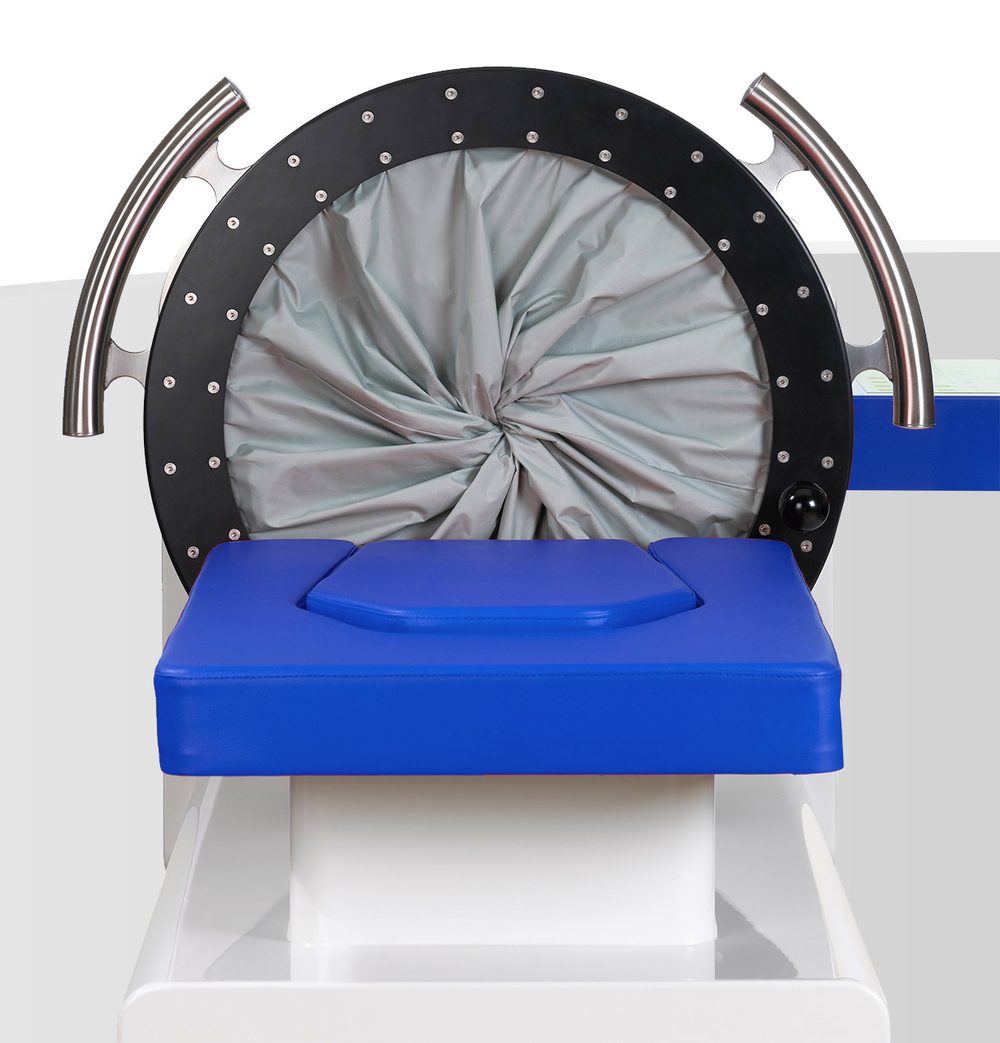
Vacumed: an intermittent vacuum therapy (IVT) device from Weyergans that improves blood flow and microcirculation in the lower limbs with cycles of negative and normal pressure. A non-invasive, painless option for arterial disease, diabetic foot, venous insufficiency and oedema. Sausport offers Vacumed to hospitals and clinics.

What problem Vacumed solves
Five ideas to understand the therapy, according to the manufacturer, and what they mean in clinical practice.
- 01
The problem: poor circulation
When blood does not reach the tissues properly, pain on walking, cramps, wounds that do not heal and swelling appear. Many of these problems start in the microcirculation, before symptoms become obvious.
- 02
How it works: intermittent vacuum
The patient lies down with the lower body inside the device. Cycles of negative pressure (vacuum) and normal pressure dilate and compress the vessels rhythmically, like an external second heart.
- 03
What it stimulates
According to the manufacturer, the flow creates shear forces on the endothelium, releasing nitric oxide (NO), favouring the formation of new capillaries and improving venous and lymphatic return.
- 04
Painless and drug-free
A non-invasive, comfortable therapy without relevant side effects, according to the manufacturer. It complements the medical treatment and wound care already under way.
- 05
Origin in space medicine
The technology was created to prevent circulatory complications in astronauts in microgravity and was adapted to vascular medicine, rehabilitation and orthopaedics.
See Vacumed in action
Official manufacturer video.
How intermittent vacuum therapy works
Two alternating phases, each with its own effect.
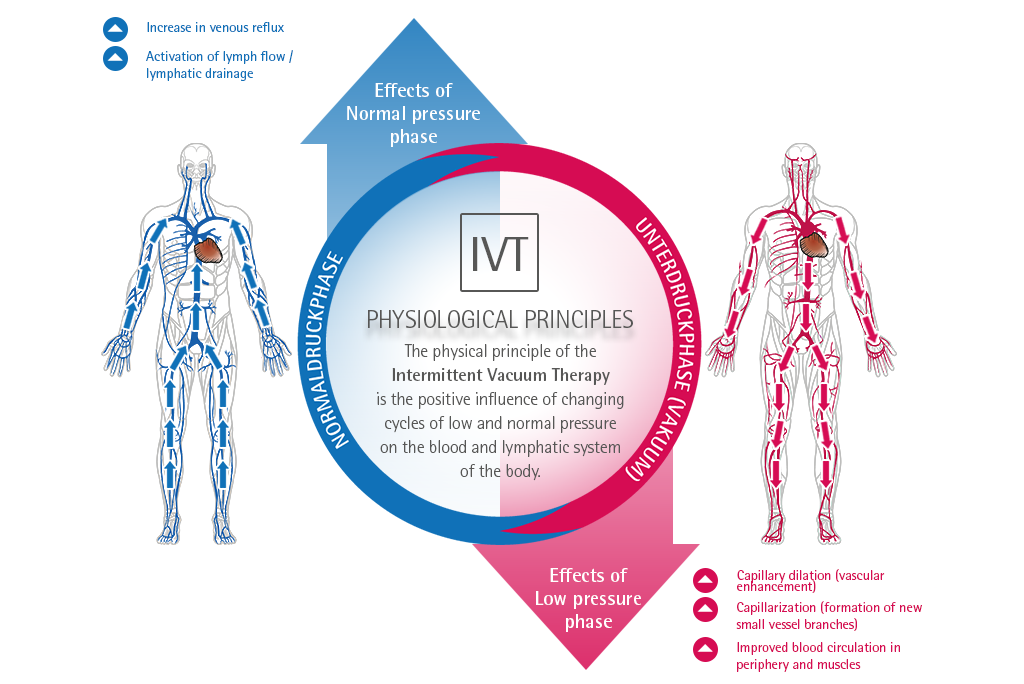
Official diagram of the physiological principles of IVT.
- Negative-pressure phase (vacuum)The vessels dilate and blood flow increases, including in the smallest capillaries. New capillaries form and nitric oxide is released.
- Normal-pressure phaseThe vessels contract and the venous and lymphatic systems decongest: venous return and lymphatic drainage improve.
Clinical areas
Indications presented by the manufacturer for Vacumed.
- 01
Peripheral arterial disease
All Fontaine stages (I to IV), arterial ulcers and Raynaud's syndrome.
- 02
Diabetes and diabetic foot
Microangiopathy, polyneuropathy and slow-healing wounds.
- 03
Venous insufficiency and oedema
Chronic venous insufficiency, post-thrombotic syndrome, lymphoedema and post-operative oedema.
- 04
Vascular-related erectile dysfunction
An alternative or complement to oral therapy when the cause is vascular.
Two clinical areas, one technology
Choose the area to see the indications, benefits and frequently asked questions.
Arterial disease, diabetes and diabetic foot
More oxygen and nutrients for the tissues, support for wound healing and a lower risk of amputation.
View solutionVenous insufficiency and oedema
Better venous and lymphatic return, less oedema, lighter legs and support for venous ulcer healing.
View solutionAt a glance
| Method | Intermittent vacuum therapy (IVT), negative pressure down to −70 mbar in cycles with normal pressure |
|---|---|
| Manufacturer | Weyergans High Care AG, Germany |
| Programmes | 8 preset treatment programmes for vascular medicine, upgradeable |
| Session length | On average 30 to 45 minutes |
| Versions | Standard and SL (electrically extendable bed for patients with reduced mobility) |
| Dimensions | 2200 x 880 x 1100 mm (SL: 3050 mm with the bed extended) |
| Weight and capacity | Device approx. 140 kg (SL 185 kg). Patient up to 180 kg (SL 120 kg) |
| Power supply | 230 V, 50 to 60 Hz, 800 VA (other voltages available) |
| Classification | Class IIa medical device, notified body TÜV Süd (according to the manufacturer) |
Frequently asked questions
What is intermittent vacuum therapy (IVT)?
It is a physical therapy that alternates cycles of negative pressure (vacuum) and normal pressure on the lower body. The aim is to improve blood and lymph flow and microcirculation, non-invasively.
Which patients is Vacumed indicated for?
According to the manufacturer, for peripheral arterial disease, diabetic foot and diabetic polyneuropathy, chronic venous insufficiency, oedema and lymphoedema, hard-to-heal ulcers and vascular-related erectile dysfunction.
Is the therapy painful or does it have side effects?
According to the manufacturer, it is painless, comfortable and without relevant side effects. The patient lies down during the session.
How long is a session and how many are needed?
A session lasts 30 to 45 minutes on average. The number of sessions depends on the indication and is set by the healthcare professional.
What are the contraindications?
Hypotension with a tendency to collapse, recent phlebothrombosis or risk of thromboembolism, infected wounds in the application area, pregnancy and joint hernia.
How can I request information or a demonstration?
Through the contact form at the end of this page. The Sausport team replies with technical information and the conditions for your facility.
Learn more about Vacumed
One page per clinical area: arterial disease and diabetes, and venous insufficiency and oedema.